Hi there!
To get started, invite family members to your wallet and assign roles!
Add Yourself
Name
Send code
Mobile Number
What are your goals for this member?
Mobile Number
Add Family Members
+ Teen
+ Parent
Choose your avatar

$230.50
Family Balance Remaining
$87
spent this week
Hey, Anjali!
Family
Alex
Henry
Settings
Home
Family
Activity
Recovery
Alex Garg
Spent $12.50 of $100
$100 left
Alex Garg
Spent $87 of $100
$13 left
Family Allowances
Recent Activity
Airpod Replacement Case
-$59.00
Henry Garg
2h ago
Alex’s Weekly Allowance
Alex Garg
6d ago
+$100.00
View All Transactions

PRODUCT DESIGNER
MOBILE APP
WEB3
PocketFi
Designed a family banking app that makes blockchain invisible.
TIMELINE
2-day sprint, Fall 2025
TEAM
Independent Project
ROLE
Product Designer
TOOLS
Figma
LONG STORY SHORT
I designed a Web3 wallet for a non-native audience
PocketFi was a solo, two-day sprint: a family banking concept built on account abstraction (ERC-4337), designed for parents and teens who have never touched a crypto wallet and never want to.
In 48 hours, I took the product from concept to a complete interaction system:
01
Product Strategy
Defined how account abstraction could remove seed phrases, gas, and network selection from family banking.
02
Interaction Design
Designed distinct onboarding, spending, allowance, and recovery flows for parents and teens.
03
Visual Design
Built a reusable component library and visual system in Figma within 48 hours.
INSPIRATION
I wanted to design a Web3 product that didn’t feel like Web3.
Most Web3 products assume users already understand wallets, gas, networks, and seed phrases. I wanted to design for people who didn’t (and shouldn’t have to). Because allowances are often a child’s first experience managing money, I explored how programmable accounts could give parents control while helping teens build financial independence (great for me to learn as a college student as well!)
How might we give families programmable control and shared visibility without requiring them to understand blockchain?
RESEARCH
To create the most effective product, I researched.
Parents and teens do not have to buy crypto or think about what the chain is. Meet ERC-4337, the account abstraction method that handles all of that in the background.
Parents and teens never have to buy crypto or think about transaction costs.
How: a Paymaster quietly pays network fees on the family’s behalf, so nobody needs their own crypto to get started.
No more gas fees
Parents set a weekly allowance. If a teen tries to overspend, the wallet blocks it automatically.
How: every purchase is checked against the family’s rules before it’s approved, the same way a debit card checks your balance.
Real Spending Limits
If a phone is lost or a password is forgotten, nobody loses access to the family’s money.
How: 2 of 3 family members (or a Face ID/Passkey) can approve a recovery — so there’s no single point of failure.
Easy Recovery
DESIGN PROCESS
My goal was to make blockchain feel invisible.
Designed for crypto newcomers.
I wanted this app to feel intuitive, to present web3 in such a way where it is accessible to anyone, regardless of their technical background. My goal was to make the technology feel human and inviting. I kept coming back to this app and thinking: would my mom get this?
Visual System
Be Vietnam Font
Be Vietnam Font

I used a playful but structured visual system to make financial management feel approachable for younger users while remaining trustworthy for parents.
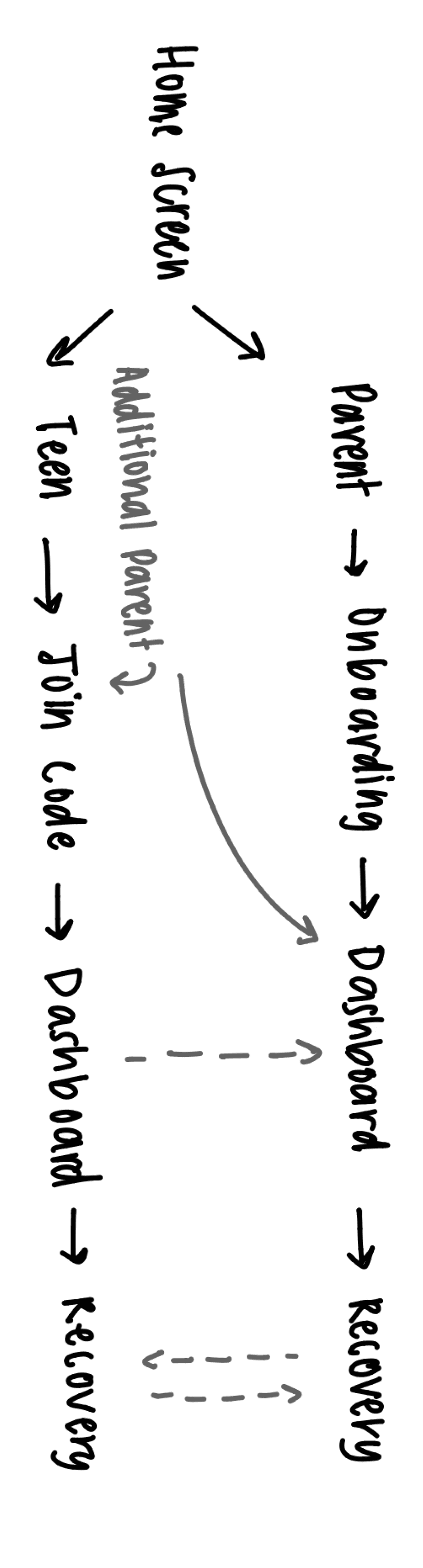
Understanding User Flow:
Parents and teens follow separate onboarding paths based on their roles, then enter connected dashboards. Parents manage family accounts and permissions, while teens track their own spending, allowance, and savings.
PocketFi uses ERC-4337 account abstraction to move blockchain complexity into the background. Instead of managing seed phrases, gas fees, or networks, families interact with familiar controls for allowances, spending, and saving.
BREAKDOWN
Onboarding without the usual crypto friction
Parents and teens each get their own unique login. A parent sets up the household and invites members, while a teen joins through a simple code, no crypto knowledge required from either side (that’s the point!)

Elements
Invisible Infrastructure
ERC-4337 powers each account behind the scenes without exposing users to wallet setup or blockchain terminology.
Role-Based Onboarding
Parents create and manage the household, while teens join through a shorter, age-appropriate onboarding flow.
Programmable Allowances
Parents can define allowance amounts, schedules, and spending limits during setup rather than managing each payment manually.
Two views, one family
Parent and teen dashboards share the same visual system while surfacing different priorities. Parents see household balances, activity, and controls; teens see their available allowance, spending, and savings goals.


Recovery without a seed phrase
I wanted to preserve the “trust” aspect of blockchain by creating a recovery system. If a phone is lost or a password is forgotten, no one loses access to the family’s money. Recovery works through people and biometrics families already trust, with no seed phrase to remember or lose. This ensures families still get the perks of PocketFi being on the chain, without the stress.

Toggle to go from Low to Hi Fidelity!
Get approval from 2 out of 3 family members
Family Recovery


If biometrics aren’t an option, 2 of 3 family members can approve access , so no single forgotten password locks the family out
Use biometric authentication (fingerprint, face ID, etc.)
Passkey Recovery


Biometric authentication lets a single family member regain access instantly, the same way they would unlock their phone
FINAL PROTOTYPE
REFLECTION
What I learned
The best design is invisible
The hardest part of PocketFi wasn’t designing the screens. It was deciding which information belonged on them. I learned that making a complex product feel simple takes careful choices about what to explain and what to handle behind the scenes.
Challenging traditional design is key
I went through many iterations of this prototype before deciding on something that I would never have expected a Web3 app to look like: bright colors, animated icons, rounded corners. Each choice was intentional and each helped me challenge my biases of design, especially as it relates to Web3 design.